
See also


 20.11.2026 12:50 AM
On Thursday, AUD/USD extended its decline, hitting a fresh yearly low. The Australian dollar remains under meaningful pressure from the US dollar: weak Australian labor-market data raised expectations that the Reserve Bank of Australia (RBA) has finished its tightening cycle.
Since early November, the Aussie has fallen roughly 4.5% against the US dollar, making it one of the weakest G10 currencies. The decline reflects a combination of factors: deteriorating domestic conditions, softer commodity prices and a stronger US dollar.
The latest Australian Bureau of Statistics (ABS) labor report disappointed. In October Australia's unemployment rate rose to 4.9% — the highest since June 2021. In September, the rate was 4.7%, and the market had expected it to remain unchanged. Employment fell by 43.5k jobs versus a consensus forecast for +25k. With revised September data showing a 36.4k decline in employment, the negative trend has clearly persisted for several months.
These figures create a dilemma for the RBA, which raised rates by a cumulative 125 basis points this year to fight inflation. The cash rate now sits at 4.85% — the highest since the 2008 global financial crisis. At the same time, mounting signs of an economic slowdown call into question the case for further tightening. Note that the October job losses and the jump in unemployment to 4.9% — a level the RBA itself had projected would not occur until late 2027 — effectively remove much of the argument for additional hikes.
Labor-market weakness reinforces concerns already reflected in the minutes of the RBA's recent policy meeting. Three committee members dissented from the latest increase, warning that restrictive policy could trigger a more significant slowdown. This suggests the RBA is likely to be more cautious about further rate increases in the near term.
Nevertheless, inflationary pressures prevent the central bank from declaring victory over rising prices. In Q3 Australia's Wage Price Index rose 1.1% q/q, above the 1.0% expectation, and annual wage growth accelerated from 3.2% to 3.5%. That makes it harder for the RBA to balance persistent inflation risks against a weakening labor market.
Financial markets now fully price the first RBA rate cut by August 2027 — a notable reversal from prior expectations of continued tightening.
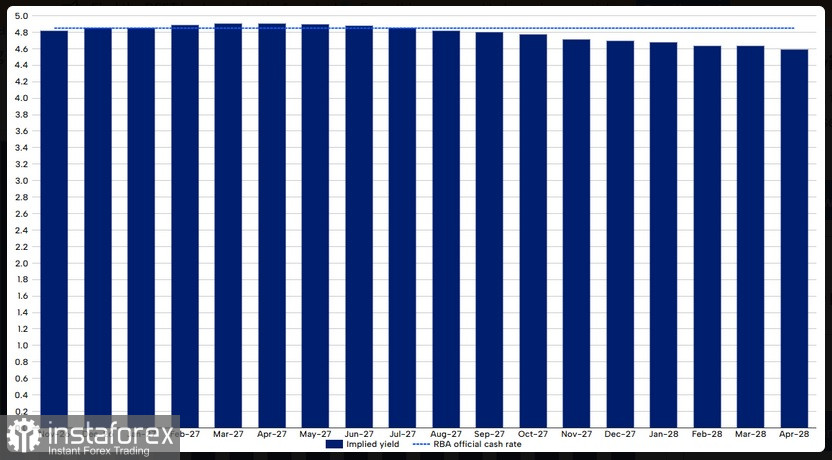
The Australian dollar is also under pressure from a widening divergence in monetary-policy expectations between Australia and the United States. While markets increasingly price in the possibility of RBA rate cuts, the U.S. Federal Reserve remains hawkish amid persistent inflationary pressure. The Federal Reserve's October meeting minutes showed that policymakers expect further rate increases may be needed to restore price stability, though they decided to wait for more economic data before acting. Fed Governor Christopher Waller reinforced that hawkish stance by suggesting a 50-bp hike in December could be considered.
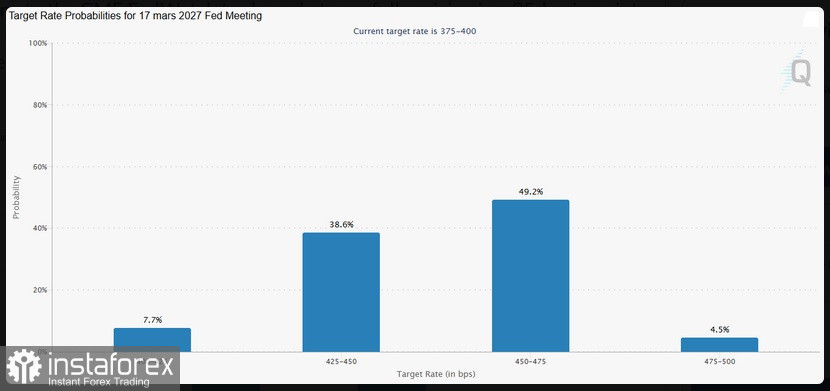
According to CME FedWatch, markets fully price a 25-bp Fed hike in December; the probability of another move in January is about 75%, and the chance of a third hike in March is roughly 55%.
The prospect of higher U.S. rates supports the dollar by raising the relative attractiveness of dollar-denominated assets. At the same time, falling commodity prices — notably iron ore — weigh on the Australian dollar given Australia's reliance on commodity exports. Rising concerns about tech stocks and shifts in global risk appetite further pressure the Aussie, which is traditionally sensitive to market sentiment.
Technically, AUD/USD remains bearish, trading below all key moving averages. Oscillators are negative, confirming the bears' advantage. But the relative strength index sits in oversold territory, suggesting a potential correction or consolidation. Support comes from the annual low, while the 9-day EMA sits near resistance. To ease bearish pressure, the pair would first need to clear the 20-day SMA near the round 0.6900 level.


