
Lihat juga


 18.11.2026 05:20 AM
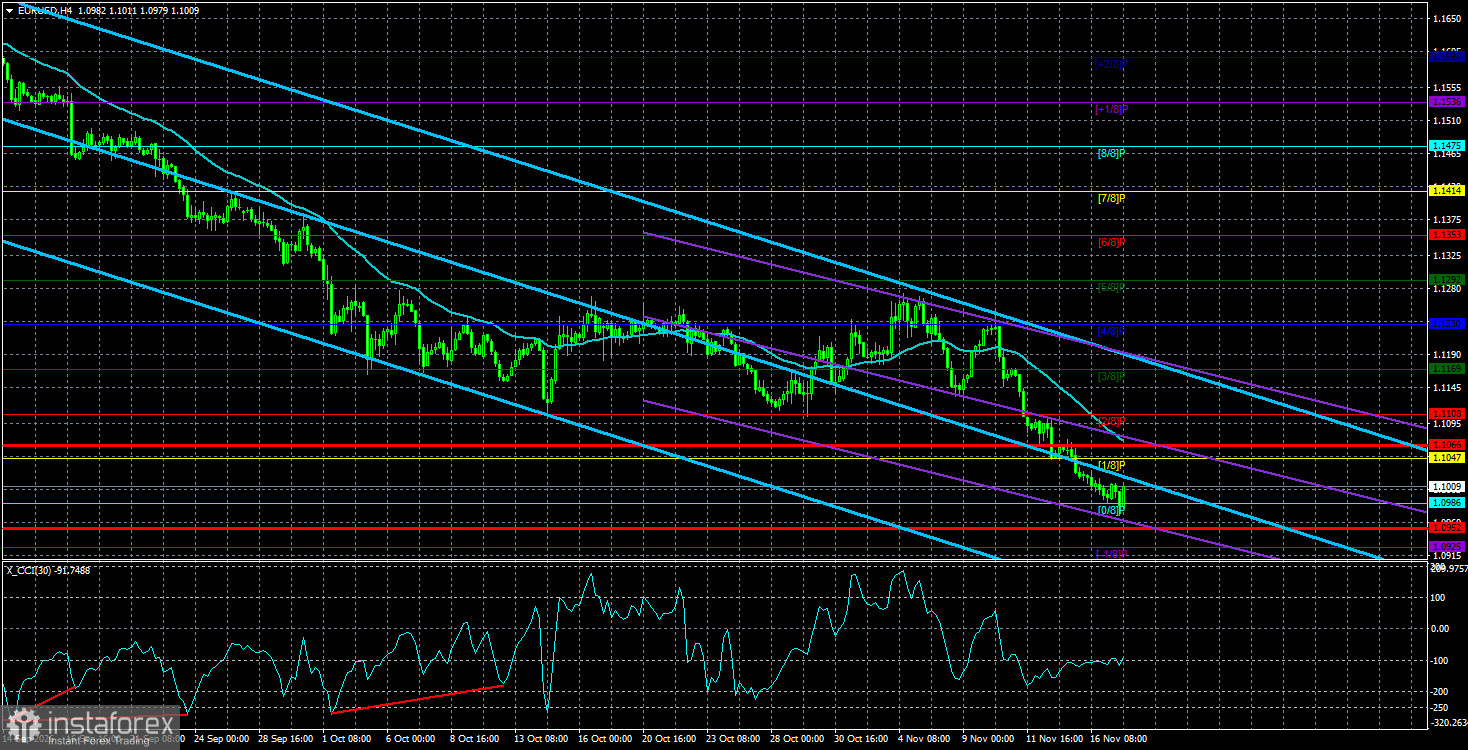
The EUR/USD currency pair continued its downward move on Tuesday, which probably surprises no one. The European currency fell for almost the entire past week, and reasons and excuses, as always, are easy to find if one is willing. Moreover, you cannot say the dollar rose sharply in the first two days of the week. No — it rises unhurriedly, by several dozen pips a day. But every day!
In principle, the situation in the FX market on Tuesday did not change at all. The euro kept falling, and the dollar kept rising at the same pace. Above we said that reasons to sell EUR/USD can be found every day if someone wants to. For example, on Monday the EU industrial production report showed a weak reading, and on Tuesday the ZEW indices could have shown more optimistic figures. However, the point is not even that the market ignores most macroeconomic and fundamental factors. The point is that it no longer reacts to anything. For example, when an important report is released, we would see a sharp spike in market volatility, intensified movement, and a price reversal in the opposite direction. That is called a market reaction. Now we see only one-sided movement at the same pace, day or night.
In our view, no new evidence is needed to support the illogical and anomalous nature of the current move. Three months ago we already said the dollar had no grounds for such a strong rise, since the European Central Bank is tightening faster and more aggressively than the Federal Reserve. Yes, perhaps the US economy looks stronger and more often delivers positive readings. Yes, perhaps the Fed will ultimately raise the policy rate even more than the ECB. However, the first factor is not strong enough for the euro to fall almost every day for three months straight without a single correction. And the second factor is only a hypothesis bordering on fantasy.
Thus our view remains unchanged. We are observing a purely speculative move. The dollar rises only because it is being bought. And it is bought because it is rising. The current movement has nothing to do with fundamentals, macroeconomics, or geopolitics. The experts who write the same thing every day about rising "hawkish" expectations are only now beginning to realize something doesn't add up. If US inflation continues to rise, how much longer will the market keep buying dollars on the "rise of hawkish expectations"? Until next March? We don't deny this is an important factor and may be a reason for the dollar's rise. But not permanent, not uninterrupted, not three months long.
Traders can certainly trade the current move with short positions, because it is hard to imagine a simpler strategy. Just remember one thing: such moves end at the most unexpected moment —not after some important event in the euro's favor, but for no particular reason at all—when the market gets tired of buying the dollar and ignoring everything else.
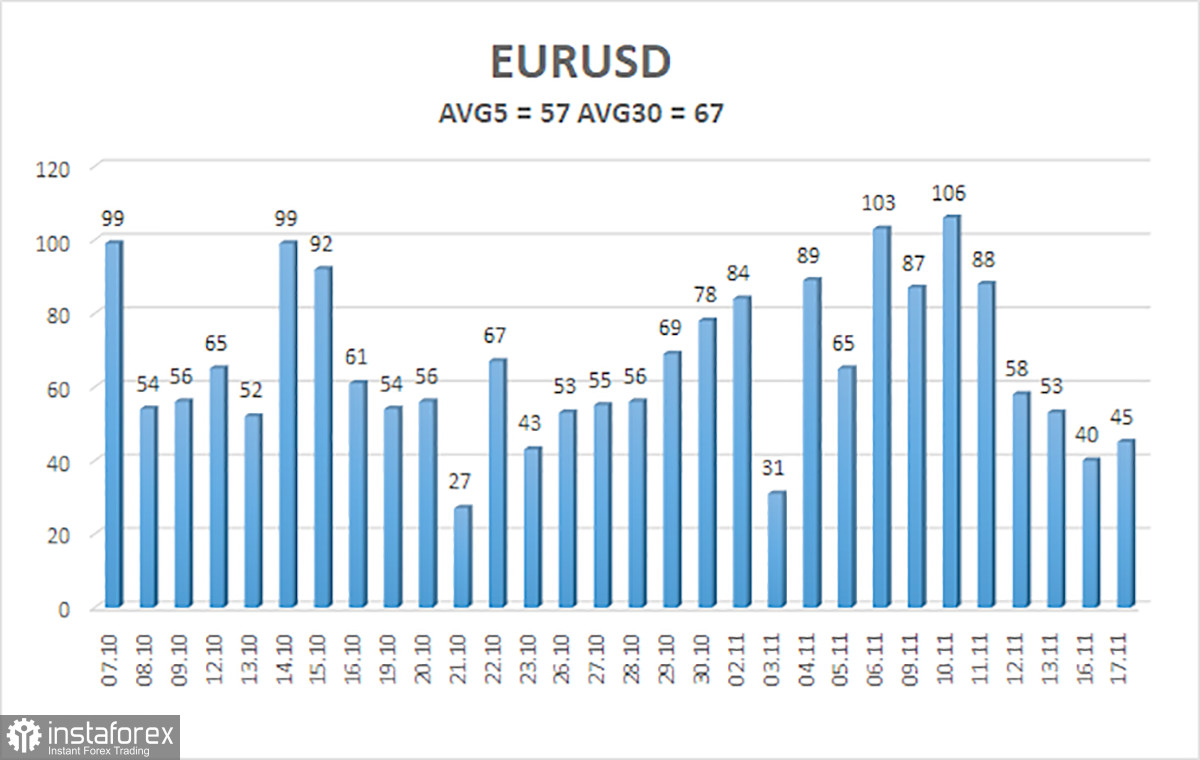
The average volatility of the EUR/USD currency pair over the last 5 trading days as of November 18 is 57 pips and is characterized as "average." We expect the pair to move between the levels 1.0952 and 1.1066 on Wednesday. The higher linear regression channel is directed downward, indicating a downtrend. The CCI indicator entered the oversold area five times and formed four "bullish" divergences, and all these signals were ignored. The illogical downward trend persists.
S1 – 1.0986
S2 – 1.0925
S3 – 1.0864
R1 – 1.1047
R2 – 1.1108
R3 – 1.1169
The EUR/USD pair remains in a descending channel with insufficient fundamental, macroeconomic, and geopolitical justification. The global fundamental backdrop for the dollar remains negative, but in 2026, geopolitics and then the Fed's hawkish stance provided strong support for the US currency. Practically all other factors have been ignored for the past three months. With the price below the moving average, short positions can be considered, targeting 1.0952 and 1.0925, since the trend remains downward. Above the moving average, long positions can be considered, targeting 1.1169 and 1.1230, because the illogical fall will end sooner or later.


