
Veja também


 18.11.2026 01:08 PM
Review of trades and trading advice for the euro
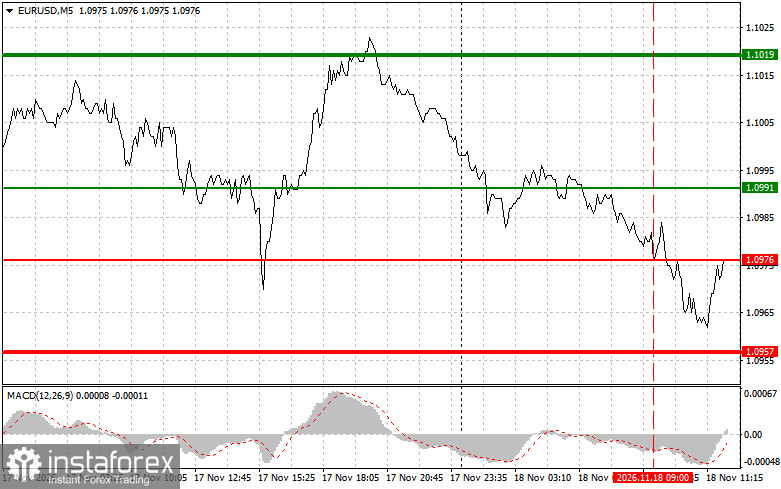
The test of the 1.0976 level occurred when the MACD indicator had already moved significantly below the zero line, which, in my opinion, limited the pair's downward potential. For this reason, no euro sell positions were opened.
In simple terms, the main takeaway from the final eurozone inflation data is that prices continue to rise rapidly, while the overall picture has deteriorated slightly more than expected. The headline inflation rate was confirmed at 4.0% year over year, up from 3.8% in September, while the core inflation rate, which is considered the most important indicator for the ECB, rose to 2.6%, compared with the forecast of 2.5%. At its October 29 meeting, Lagarde said that the central bank would review incoming data before December, placing particular emphasis on core inflation. The latest reading makes the case for those advocating a pause more difficult. However, this had no impact on the euro, as market attention remained focused on the US dollar.
The main event for the euro during the second half of the day will be the release of the Fed meeting minutes. This detailed report covers the October 27–28 meeting, at which the decision to keep interest rates unchanged was approved by a 10–2 vote, with Hammack and Cook voting in favor of a rate hike. The minutes will show how many policymakers favored further tightening, how they assessed inflation and labor market conditions, and how seriously they considered a rate hike in December. The market will be looking for an answer to one key question: will the December 9 rate hike be a firm decision, or will uncertainty remain?
The implications for the euro are straightforward. Futures markets have already priced in 25-basis-point rate hikes in December, January, and March. Therefore, hawkish minutes would merely confirm existing expectations and support the US dollar, while dovish minutes could weaken it slightly but would not eliminate the policy divergence. The ECB's deposit rate stands at 2.50%, against inflation of 4.0%, and the central bank is only preparing to raise it to 2.75%. Meanwhile, the Fed maintains its interest rate in the 3.75%–4.00% level.
As for the intraday strategy, greater emphasis will be placed on implementing Scenarios #1 and #2.
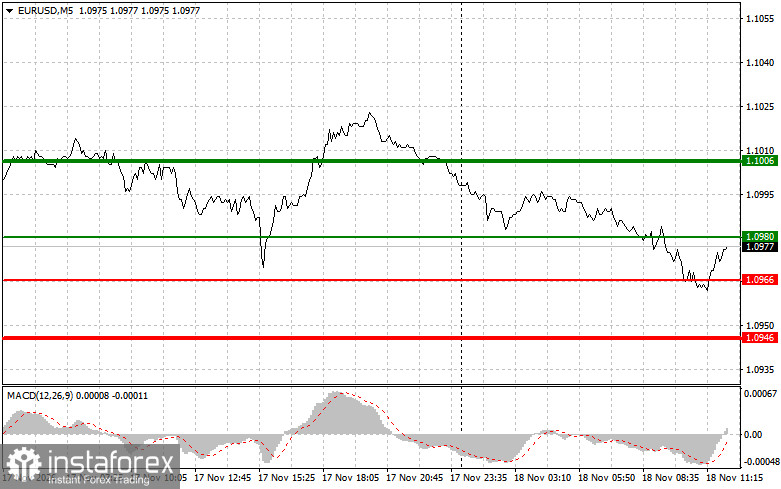
Scenario #1: Today, buying the euro is possible when the price reaches the 1.0980 level (the green line on the chart), with a target of 1.1006. At 1.1006, the position will be closed, and a reverse sell position will also be opened, targeting a move of 30–35 points from the entry point. A rise in the euro today can be expected if US economic data comes in weaker than forecast.
Important! Before buying, make sure that the MACD indicator is above the zero line and has only just begun to rise from it.
Scenario #2: The euro will also be considered for buying today if the price tests the 1.0966 level twice consecutively while the MACD indicator is in oversold territory. This would limit the pair's downward potential and trigger an upward market reversal. A rise toward the opposite levels of 1.0980 and 1.1006 can be expected.
Scenario #1: The euro is expected to be sold after the price reaches the 1.0966 level (the red line on the chart). The target will be 1.0946, where the position will be closed and a reverse buy position opened immediately, targeting a 20–25-point move in the opposite direction from that level. Downward pressure on the pair is likely to return if US economic data comes in stronger than forecast.
Important! Before selling, make sure that the MACD indicator is below the zero line and has only just begun to decline from it.
Scenario #2: The euro will also be considered for selling today if the price tests the 1.0980 level twice consecutively while the MACD indicator is in overbought territory. This would limit the pair's upward potential and trigger a downward market reversal. A decline toward the opposite levels of 1.0966 and 1.0946 can be expected.
Important. Beginner Forex traders should exercise extreme caution when making entry decisions. Before the release of major fundamental reports, it is generally best to stay out of the market to avoid exposure to sharp exchange rate fluctuations. If trading during news releases, always place stop-loss orders to minimize potential losses. Without stop-loss orders, the entire trading account can be lost very quickly, especially if risk management rules are not followed and large position sizes are used.
Remember that successful trading requires a clear trading plan, such as the one presented above. Making spontaneous trading decisions based on current market conditions is a fundamentally flawed strategy for an intraday trader.


