
Veja também


 19.11.2026 08:40 AM
The key UK release yesterday was October inflation, which came in without surprises. The consumer price index — the year-on-year measure of how much goods and services have become more expensive — printed 3.6% versus a 3.6% forecast and 3.5% in September; month-on-month prices rose 0.5% versus a 0.5% forecast and 0.4% previously. Compare with the prior release: on October 21, September's inflation surprised to the upside (3.5% vs. a 3.4% forecast), and core CPI (excluding food and energy) hit 2.8% versus a 2.7% forecast, and the pound rose. This time the figures matched expectations, leaving pound buyers with nothing to lean on.
Pressure on the pair persisted, however, and the reason was in the U.S. The Federal Reserve minutes from the October 28 meeting were released and sounded hawkish. The rate was left unchanged on a 10–2 vote, yet almost all participants expect another hike, and two members even allowed for a step larger than 25 bps as soon as December if inflation disappoints. By comparison, in the September minutes all 19 participants voted for a hike and most expected only one more move by year-end.
Today attention returns to the UK. The CBI Industrial Trends Orders Balance for November will be released and is expected at -29 after -32 in October. The index is based on a survey of manufacturers. It shows the difference between the share of firms reporting orders above normal and those reporting below normal, so a negative reading means orders are below usual levels. In September it stood at -9, then plunged to -32 in October versus an expected -20, and the pound fell after a failed attempt to break the weekly high. Also speaking today will be Swati Dhingra, an MPC member at the Bank of England. She was previously one of the more dovish voters—in November 2025 she voted for a cut at a 4.00% rate—but on November 5, 2026, she supported a hike. In my view, a weak CBI reading combined with an unchanged or softer tone from Dhingra will not support the pound; any dovish shift in her comments would add pressure to GBP/USD.
Now GBPUSD stands at 1.3132, inside the range between 1.3107 and 1.3150, 18 pips below the upper boundary. A move beyond the border is a breakout, but one touch is not enough—consolidation is required, meaning several consecutive five-minute candles must close beyond the level. Otherwise, it is easy to get caught on a false spike, after which the price will return.
From above 1.3150 is active. Consolidation above it opens the way to 1.3187 and then to 1.3224. Overnight, the price rose to 1.3152 — i.e., two pips above the level — but failed to hold and returned lower, so this is a proven ceiling. The first target 1.3187 lies near the area around 1.3192, from which the drop on November 18 began, and the second 1.3224 is near the November 17 high around 1.3227, so sales often occur in both zones. UK inflation came in as expected, the CBI index is unlikely to please, and the hawkish Fed minutes support the dollar, so I have little faith in this upside scenario.
From below, the reference is 1.3107; consolidation below it leads to 1.3073 and then to 1.3038. I consider this direction primary. Since November 10, when the pair was around 1.3449, GBPUSD has lost about 320 pips, and pressure has not eased. Overnight the price fell to 1.3119 — 12 pips above the level — and bounced roughly 16 pips. A true breakout requires consolidation below, not another poke. If a weak CBI reading coincides with dovish comments from Dhingra, the decline could be rapid. I would not enter on the first touch.
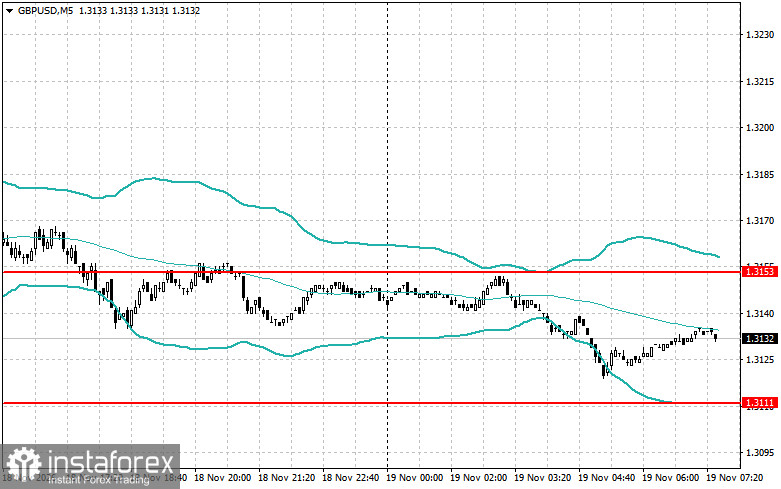
There are two levels here: 1.3153 and 1.3111. The upper reference, 1.3153, lies only three pips above the buy breakout point, 1.3150, so special caution is required. These two marks sit very close together, and on the first touch it is impossible to tell which scenario has been triggered. If the price consolidates above 1.3153, the upward breakout is working, and you must not sell there. If, however, it reaches 1.3153, finds no continuation, and quickly returns below, I consider selling toward 1.3111 with a stop above 1.3159. Overnight, price rose to 1.3152—literally to this zone—and reversed. This picture is most likely to repeat if the CBI prints close to the forecast and the market retraces after the initial reaction. The difference between the two scenarios may take several minutes, so it is better to skip the first reaction in the zone.
The lower reference 1.3111 sits four pips above the sell breakout point 1.3107 and 21 pips below the current price, so it is easy to err here. The scheme is this: the price falls to 1.3111, cannot consolidate below, and returns above, and then I look to buy toward 1.3153 with a stop below 1.3107 with a small margin. A buffer is essential because price sometimes slips one or two pips below the level, and a stop exactly at 1.3107 would have been hit. Such a rebound is most likely if the Fed offers no new hawkish words and the market starts taking profits after the decline. If the price confidently consolidates below 1.3107, the return is canceled and the downward breakout to 1.3073 works.


